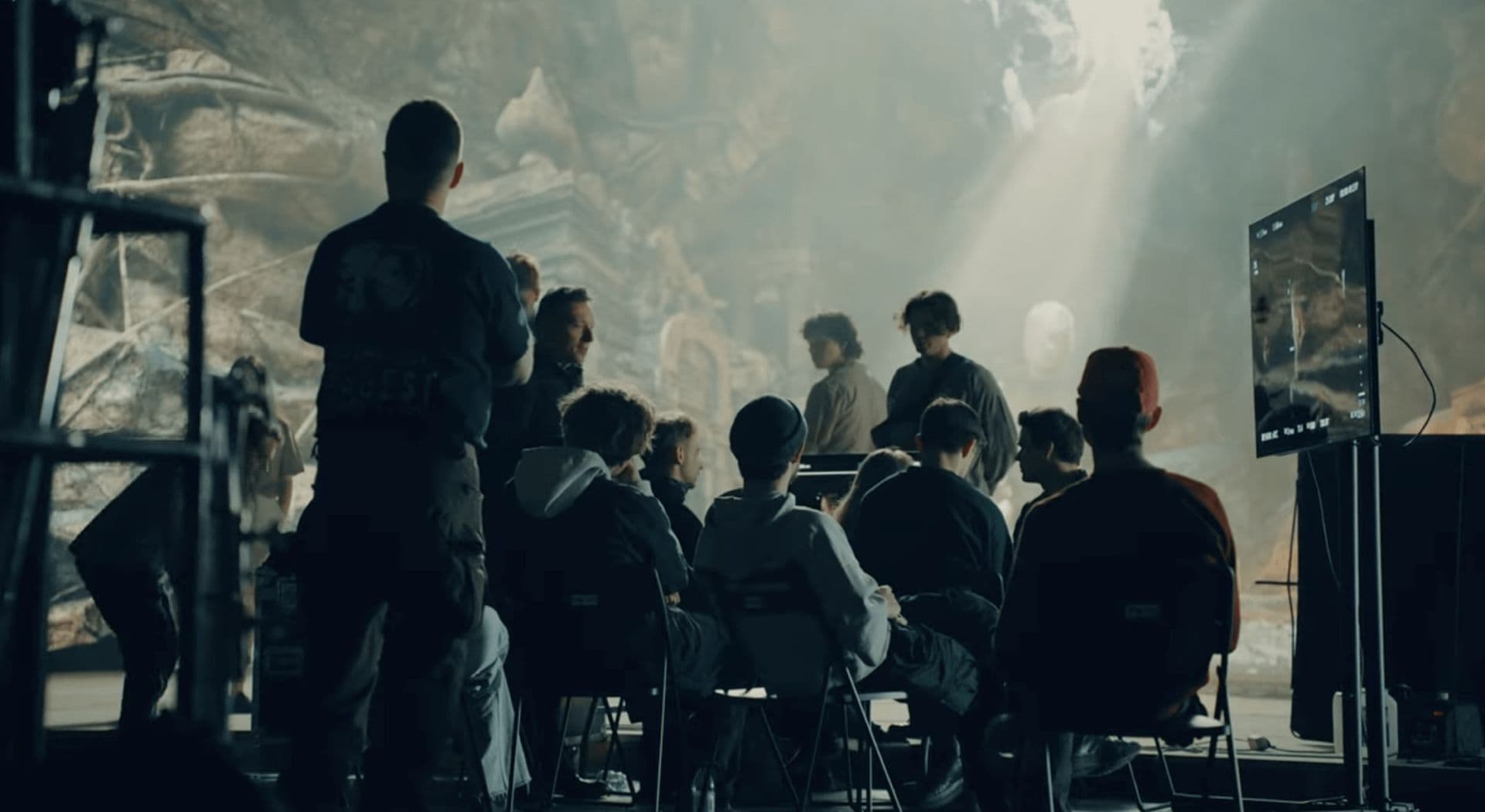
During the 34th edition of ToruńCAMERIMAGE, we will once again come together on a film set. With the partial opening of the newly built CAMERIMAGE Film Studio, we will return to one of our Festival’s most valued traditions: workshops where masters of filmmaking and emerging filmmakers work side by side, sharing knowledge, experience and creative ideas.
We believe that a film set is the best place to explore the art and craft of cinematography. It is here that theory meets practice, and workshop participants can observe the creative process, gain insight into the decisions made by outstanding cinematographers, and discover how lighting, camera movement and the choice of viewpoint shape the character and meaning of a scene.
The CAMERIMAGE Film Studio is the first phase of the European Film Center CAMERIMAGE, currently under construction, which is intended to become a year-round space for encounters, education and creative collaboration. Although the Studio is scheduled to become fully operational in mid-2027, we will open its doors to Festival participants this autumn.
During this year’s edition, we plan to hold at least two workshops using the LED wall. They will offer an opportunity to explore the potential of modern filmmaking technologies, exchange experiences and pursue creative ideas together, while providing a preview of what the CAMERIMAGE Film Studio will offer filmmakers in the future.
VIRTUAL PRODUCTION AND NEW TECHNOLOGIES - led by Arthur Reinhart, with a Surprise Guest
Engaging in hands-on exploration of real virtual LED film set productions, attendees will experience live work with light and camera using virtual sets and in-camera VFX techniques. Led by cinematographer Arthur Reinhart and his special guests, the session will demonstrate how to successfully integrate classic cinematography with cutting-edge LED technologies, empowering you to play, learn, and create within this immersive, fully interactive sandbox. The Studio will become a space for experimentation, breaking rules and discovering new visual possibilities, without the pressures of a typical film shoot.
Students will have the opportunity to explore:
- Working on an LED stage - the practical use of lighting and cameras in virtual environments.
- In-camera visual effects (ICVFX) - combining live action with digital backgrounds and set extensions generated in real time.
- Hybrid cinematography techniques - seamlessly combining traditional camera techniques with cutting-edge LED technology.
ARTHUR REINHART
Cinematographer, editor and producer. A graduate of the Łódź Film School, where he now teaches, Reinhart has established himself as one of Poland’s most compelling cinematographers. His work is distinguished by a keen eye for the beauty of the frame and often departs from realism, leaving a lasting impression on viewers. He has won three Golden Frogs at ToruńCAMERIMAGE for Crows (1994), I Am (2005) and Venice (2010), as well as two Golden Lions in Gdynia and two Polish Film Awards - Eagles.
THE VISUAL LANGUAGE OF EMOTION - led by Anka Malatyńska
Six hours. One space. One film created together.
How can light reveal a thought, a lens create intimacy, and a frame express longing?
During this hands-on workshop, participants will work with cinematographer Anka Malatyńska to develop and shoot a short film with a particular emphasis on visual storytelling. Working with actors and a professional crew, they will explore how lenses, lighting, composition and camera movement shape emotion.
Inspired by Bruce Block’s book The Visual Story, which offers a clear perspective on the relationship between narrative and a film’s visual structure, Malatyńska invites participants to share ideas, test creative choices in practice and discover their own voices through a collaborative creative process.
ANKA MALATYŃSKA
An award-winning cinematographer, creator and educator. She has worked on productions for HBO, Netflix, Hulu and Amazon, as well as films presented at international festivals, including Venice and Toronto. Named one of Variety’s “10 Cinematographers to Watch”, she is an internationally respected lecturer, mentor and workshop leader, passionate about advancing the art and craft of visual storytelling.
There will also be workshops on new technologies. One of them is WHEN THE FRAME DISAPPEARS - led by Martin Demmer
What happens to cinematography when the audience is free to choose its own point of view? This workshop introduces volumetric video as a human-centred recording medium in which real performances are captured in three dimensions and experienced beyond the traditional frame. Through live infrared capture, practical lighting experiments and hands-on demonstrations, participants will explore how light, shadow and attention shape spatial storytelling while gaining insight into production workflows and the evolution of the medium from mesh-based capture to 4D Gaussian Splatting. Rather than replacing cinema, volumetric video expands the language of cinematography into immersive forms of storytelling.
MARTIN (MARTN) DEMMER
Martin (Martn) Demmer is a cinematographer, volumetric filmmaker and spatial storytelling researcher working at the intersection of cinema, XR and immersive media. Over the past decade, he has explored human-centric volumetric capture and emerging forms of visual storytelling for VR, AR and location-based experiences. Martin has led workshops and interdisciplinary teams focused on innovation in cinematography and narrative design. His work investigates how cinematographic language evolves when stories move beyond the traditional frame.
Toruń - CAMERIMAGE Film Studio is here
The European Film Center CAMERIMAGE Studio is taking shape in Toruń, creating new opportunities for films, commercials and educational productions, supported by technologies including virtual production (VP). The Studio is the first phase in the construction of the European Film Center CAMERIMAGE, a complex that aims to bring together professional film production, education and creative collaboration.
Virtual production technology, which gained worldwide recognition through productions such as The Mandalorian, makes it possible to create realistic, three-dimensional environments displayed on large LED screens. By integrating film cameras, camera tracking systems and graphics engines that generate imagery in real time, the perspective of the digital environment changes as the camera moves. Light emitted by the screens interacts with actors and physical set elements, allowing the real and virtual worlds to blend naturally. This enables filmmakers to shoot scenes in distant or entirely fictional locations without leaving the soundstage, while capturing some visual effects directly in camera.
The Studio building comprises two underground levels and five above-ground levels, housing a soundstage alongside post-production, technical and administrative facilities. Its distinctive, irregular form is complemented by an LED screen of approximately 170 m², wrapping around the corner of the upper section of the north- and east-facing façades.
At the heart of the Studio is a soundstage measuring 27.6 × 17.7 m, with a height of approximately 15 m. It will be equipped with a system of chain hoists, each with a lifting capacity of 500 kg, allowing lighting rigs and an overhead LED screen to be raised. The position and angle of the overhead screen will be adjustable to suit the needs of each scene. Together with a curved main screen measuring 22 × 6 m and mobile screens, this will create an advanced virtual production environment, giving filmmakers the freedom to combine physical sets with digitally generated surroundings.
More than 165 m of curtain tracks will run around the soundstage, carrying white, black and green curtains. A retractable curtain measuring 15 × 10 m will allow the space to be divided into two independent shooting areas. Professional lighting, sound, stage machinery and cinema systems will complete the technical installation.
Extensive technical support facilities will be an integral part of the Studio. One of the underground levels will house storage and workshop facilities occupying a combined area measuring 28 × 20 m. A transport platform measuring 4.95 × 2.25 m, with a lifting capacity of 5,000 kg, will connect these facilities to the soundstage, allowing sets and film equipment to be moved efficiently.
The Studio will also provide comprehensive facilities for picture and sound post-production. The rooms dedicated to this work will be soundproofed and acoustically treated to suit their respective functions. The second floor will house a sound and music mixing suite with a recording studio, a colour grading suite, a visual effects suite and editing rooms.
The electronic equipment serving these suites will be housed in a separate, air-conditioned server room to ensure a quiet working environment. A shared storage array will allow film material to be stored and accessed while maintaining high standards of performance and data security.
The post-production facilities will be complemented by a screening room: an intimate cinema equipped with Dolby Atmos sound, a screen more than six metres wide and a 4K laser projector. Here, filmmakers will be able to review their work, assess picture and sound quality, and make final creative decisions under professional cinema projection conditions.
The CAMERIMAGE Film Studio will be more than a place for film production and post-production. In keeping with the spirit of the CAMERIMAGE Festival, it will also become a space for education, artistic experimentation and the direct exchange of experience between established masters of cinema and a new generation of filmmakers. Above all, advanced technology will serve the creative imagination, opening up new possibilities for cinematographers and directors to tell stories through images.
Although the Studio is still being equipped and is scheduled to become fully operational in mid-2027, it will open partially for film workshops during this year’s 34th edition of the CAMERIMAGE Festival. This will be the first opportunity to explore the potential of the new space and see technology, knowledge and artistic creativity come together in practice.
The creation of the CAMERIMAGE Film Studio marks an important step in Toruń’s development as a place dedicated to presenting, promoting and creating cinema. It also marks the beginning of a broader vision for the European Film Center CAMERIMAGE: a space where the experience and traditions of cinema will meet the technologies shaping its future.